



Further developments of the turbine engine.
The previous page related the steps involved in designing, building and testing a primitive turbine engine. That page has gotten quite long and cumbersome, so all further developments related to the engine will be posted here.
11/03/99
Today I went to the Big 3 Truck Salvage Yard and drooled over the big turbos on the big diesel engines
there. I didn't even ask how much they cost so I wouldn't be too tempted to buy one if they turned
out to be affordable. I don't think I'm ready for that much power just yet. Some of them were so big
and heavy that I would need an engine hoist just to move them around. The biggest ones I saw had
inlets a good 6 inches in diameter, and must have weighed at least 200 pounds.
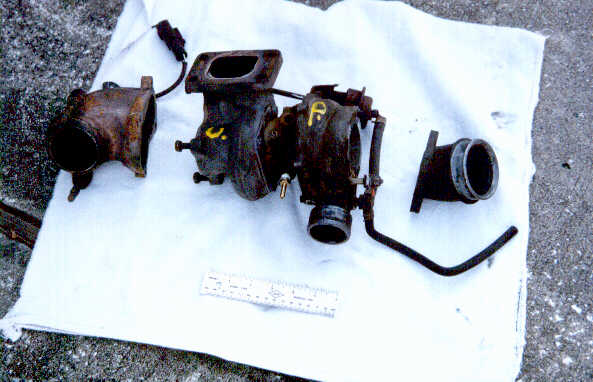 This is my second turbo charger. It was found sitting on the fender of a Thunderbird Turbo Coupe in the scrap yard. I didn't even have to get greasy pulling it off the engine. |
I'm sure I can adapt the new turbo to all the rest of the parts fairly easily. I should really only have to make two new parts. A new flange with a new pattern of bolt holes drilled in it, and a new PVC air pipe. Only minor modifications to the test stand should be needed.
I'm in no real hurry to rebuild the engine with the new turbo. I want to experiment a little with the first turbo. I also need to demonstrate the engine to some more people before I take it all apart.
11/05/99
Today I tried an idea I have been thinking about since I brought home the first turbo. I wanted to try
using compressed air to start the engine rather than the blower. I tried it several times by using my
air gun to blow air from my wimpy air compressor on the compressor wheel and spin up the turbo. I couldn't
get the engine to spin up fast enough to self-sustain. I decided that the problem was that the air gun
produced too diffuse of an air flow, and couldn't be inserted into the compressor inlet far enough to
get it really close to the compressor wheel. I made a new nozzle for the air gun that was longer and
produced a more concentrated flow. This time it worked. I managed to start the engine several times.
Now that I knew it would work I wanted to find a more elegant way of doing it than trying to hold
an air gun in just the right spot with one hand while trying to manipulate both the fuel pressure and
oil pressure valves with the other.
I ran a piece of 1/8 inch copper tubing down the inlet of the turbo until it almost touches the compressor wheel, and clamped it in place. The end of the tubing is bent at what seems like the best angle for spinning up the wheel. I also mounted an air valve in a convenient spot near the rest of the engine controls.
Now starting the engine with compressed air is dead easy. Even my wimpy little air compressor can do it. As a fringe benefit, The sound made by the air impinging on and spinning up the compressor wheel is really impressive. Now my little engine really sounds like a jet engine. If you close your eyes you could swear you are standing next to an F16 starting up it's engine.
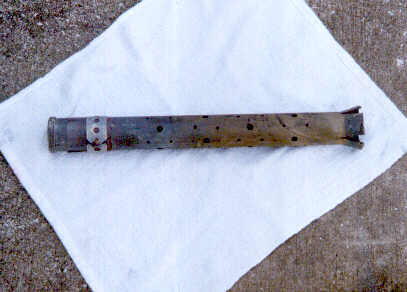 The flame tube after about 1 hour of total runtime. Badly discolored but otherwise ok. |
Now that the engine has close to an hour of total running time on it I wanted to see what wear and tear (if any) it has suffered. I completely tore down the engine and inspected it's parts. With the exception of the flame tube, most parts still looked unchanged. The flame tube is very discolored along its full length, and all the galvanizing has burned off, but it is otherwise undamaged. The spark plug is now showing quite a bit of discoloration ,but still no signs of melting. The hot end of the combustor, the flange, and the adaptor plate are all slightly discolored, but otherwise like new. The turbo seems to be unchanged.
I also tore down the oil filter/cooler assembly to find and fix an annoying and messy oil leak that has been driving me nuts. I installed new O rings and made a new gasket from silicone gasket material. this seems to have solved the problem.
When I reassembled the engine I used high-temp silicone gasket material between the flange and the adaptor plate and between the adaptor plate and the turbo. This has stopped the hot air leaks I was experiencing.
11/10/99
Today I had intended to do a long endurance run on the engine in an attempt to measure the rate of
fuel consumption. I removed the propane tank from the test stand and placed it on my bathroom scale.
I noted the weight and time, then started the engine and throttled it up to 4 psi of boost. I let
the engine run at that level while I attended to other chores. The engine is very stable and
predictable at low boost levels, and I am now comfortable enough with it's performance to leave the
controls while it is running. I had intended to run it for at least an hour, or until several pounds
of propane had been burned so that I could get a reasonably accurate measurement. I listened to the
sound of the engine as I worked and checked the boost pressure several times. It ran very stable and
the pressure gage stayed right on 4 psi.
About 30 minutes into the run I heard the engine start to slow down. It was a very gradual spool down. I came running to see what was going on. The fuel pressure was dropping and I at first assumed I had run out of propane. Then I saw all the ice on the propane tank. The tank was so cold that the internal pressure was rapidly dropping toward zero. Only about a pound of propane had been burned according to my not very sensitive scale, but all that ice probably masked some weight loss from the tank. I shut down the engine and decided to table this particular project until I find a way to prevent this problem.
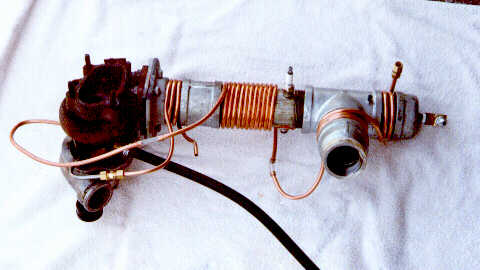 Here you can see the cooling tubing wrapped around various parts of the combustor just before I mummified it with layers of aluminium tape to improve heat transfer. The 3 wraps on the far left are to pre-heat the oil and reduce it's viscosity before it goes to the turbo. |
This weekend I tore the engine down and wrapped 1/4 inch copper tubing around the hottest parts of the combustor. Almost 20 feet of tubing was used. The idea is to circulate water through the tubing and keep the engine cool. This is not so important while it is running, but after shutdown. As long as it is running the (relatively) cool air from the compressor cools the combustor as it passes through it. Radiation from the hot flame tube and conduction from the hot end cause the cumbustor to heat up while running, but only so far. The temperature seems to reach a plateau after a few minutes and not rise much more no matter how long the engine runs. However, after shutdown the heat from the incandescent flame tube, the turbine, and the hot end of the combustor soaks into areas that should not get too hot. Cold water from my garden hose flows through the tubing, through the turbo and then out on to the ground. It seems to be helping somewhat. The temperature of sensitive areas doesn't rise much after shutdown and the whole engine cools down much quicker now.
I ran the engine quite a bit this weekend. It is not running as well as it did in the beginning. The turbo bearings seem to be getting worse with every run. It now sometimes starts wobbling at only 3.5 psi of boost. I am also seeing a lot of oil in the cooling water discharged from the turbo. I am afraid the time is coming soon when I will have to retire this turbo charger and install the new one. I spent some time this weekend working on the new flange that will mate to the new turbo.
11/20/99
Today a group of people came over to hear me lecture on the principals of gas turbine engines and
see the engine in operation. They were members of the Clearwater/Largo Amateur Astronomical
Society. Nearly the entire membership showed up to see my little engine. Although this is way off
the topic of astronomy, these folks are fascinated by all areas of science and technology just
like I am. The demonstration got off to a rocky start when my air compressor blew a circuit breaker
while I was trying to start the engine for them. Funny, it's never done that before. Once the power
was back on I got the engine started and they were all suitably impressed.
Although my guests were impressed, I was not. The engine was running very badly, and I couldn't throttle it up very high at all. It was also leaking oil worse than ever. I think this is the end for the poor tired old turbo charger. Tomorrow I will install the new turbo.
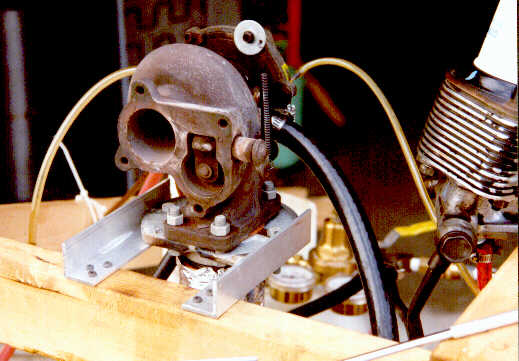 This is the new larger turbo charger. It's a Warner-Ishi IHI Turbo from an 86 Thunderbird Turbo Coupe. The long black spring on the right side is holding the wastegate shut. |
Today I replaced the original turbo charger with the new larger unit. The difference is amazing. This turbo produces a much higher mass flow at a given boost pressure than the old turbo. I would guess at least 3 or 4 times as much mass flow judging by the force of the exhaust blast. At only 5 psi of boost the exhaust blast feels like hot hurricane force wind 10 feet away from the turbo exhaust. This turbo is also quite a bit louder than the last one. This unit is also quite a fuel hog. It requires 2 or 3 times as much fuel pressure to maintain a given boost level as the other turbo did, and it tops out at about 7 psi of boost with the fuel valve wide open. At 7 psi the thrust is truly awesome. I'm surprised the test stand is not scooting across the floor. I'll need to rework the fuel injector so I can get more fuel into the engine. I will probably also need to start vaporizing the liquid propane in a heat exchanger rather than in the tank to keep the fuel pressure up.
Above about 6 psi there are occasional events that seem like little backfires. I suspect that this is the infamous compressor surge I have heard about. I will probably try bleeding off some compressor air to see if that helps the problem. I included a large air tap in the new air pipe I had to build to mate the new turbo to the existing combustor. I have plans to use some compressor air anyway to attempt to run some accessories.
I also found that the engine is now much harder to start on compressed air, especially when it's cold. It can take two or three tries to start the cold engine, but it will usually restart on the first try when it's already hot. This is probably just because the turbo is bigger and my air compressor is so small and wimpy. Someday I just have to buy a more "macho" air compressor.
11/23/99
Over the past couple of days I've been working on two different projects. Building an air motor that
will replace the electric motor driving the oil pump, and attempting to smooth out the operation of
the engine at high boost levels.
I want to replace the AC motor driving the oil pump and make the engine independent of outside power sources once it has been started. A couple of weeks ago I bought a small centrifugal blower with the idea of modifying it to operate as an air motor that would run off of compressor bleed air. I removed it's electric motor and set about making modifications. Tests using shop air showed that the completed motor spins at outrageous speed, but produces very little torque. I next built a gear train to reduce the speed and increase the torque. The finished unit was tested on bleed air from the running engine today. The unit works, but I'm still not sure it will produce enough torque to run the pump, especially at low boost pressures. I will do a test run soon with the unit actually driving the pump. If it doesn't work, I'll rework the gear train.
I have also been trying to get rid of the annoying "backfires" or surging I'm seeing at high boost pressures. I first tried bleeding off some compressor air. This didn't seem to help much. I also tried some different injectors, but they all worked much worse than the original. One of them produced some really impressive "wet" starts that made my engine act like a flame thrower. Too bad I didn't get any photos. I went back to the original injector and started messing with the air holes in the flame tube. I found that opening up the 4 air holes immediately next to the injector a little bit helped. I also found that letting the engine warm up for a while at low speed before throttling up to wide open also helped smooth out the running.
I must have started the engine 2 dozen times in the last two days. I'm getting quite good at starting it on the first try with compressed air even when it's cold. I think the problem was that I wasn't opening the fuel valve far enough fast enough. With the new turbo installed the engine is now quite a fuel hog. It took me a while to learn that I really have to give it the juice to get it going.
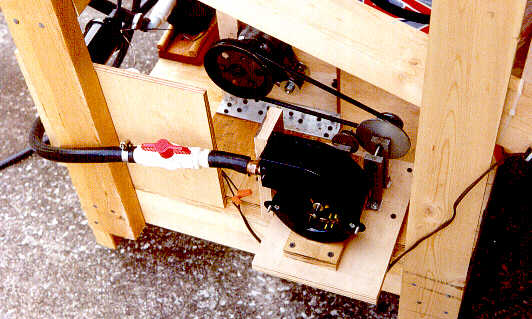 Here you can see the air motor I built to run the oil pump. The air comes through the black hose from an air tap in the pipe that delivers air from the compressor to the combustor. |
Today I removed the AC motor driving the engine oil pump and replaced it with my home made air motor. The first test was discouraging. It wouldn't start even at fairly high boost pressure. I reached down and gave it a spin, then it ran sort of half heartedly. I shut down the engine, removed the air motor, and looked for ways to make it better. I replaced the original air nozzle I made for it with a new one that produced more air flow and directed it on the wheel better. The second test went much better. the air motor started on it's own at about 4 psi of boost and produced a respectable 20 psi of oil pressure. It then sped up in step with the speed of the turbo as I throttled up the engine. I might try modifying the nozzle again to try to get it to start at lower boost pressures, but for now I'm pretty happy with it.
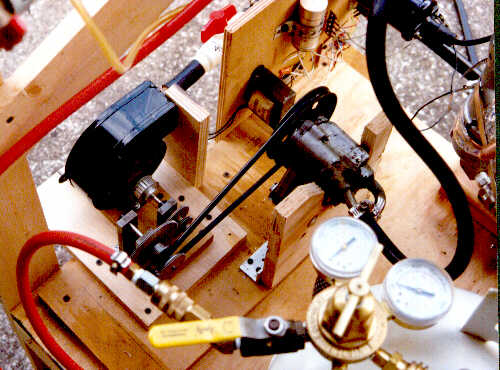 This is another view of the air motor driving the oil pump. |
11/26/99
I've gone back to the electric motor to drive the oil pump for now. Although the air motor worked, the
performance of the engine suffers. Robbing all that air from the system really reduces the top-end of
the engine. Perhaps if I were to replace the mass of the diverted air with water injection the
the performance might come back up. Water injection is a project I may attempt in the future. For now
the air motor goes on the shelf. If I ever try to make something self-propelled with this engine, I'll
probably just use a battery powered dc motor to run the oil pump and perhaps a water circulating pump.
11/27/99
Today I added a nozzle to the engine. Like everything else it is made of standard pipe fittings. A 2
inch floor flange, a 2 inch nipple 6 inches long, and a 2 inch to 1.5 inch reducer. The nozzle does a
very good job of concentrating the engine thrust into a narrow stream that doesn't diverge much and
retains much of it's force and heat far from the engine. I was very surprised to find that the thrust
stream was hot enough to burn my hand at a distance of 6 or 7 feet from the nozzle. Without the nozzle,
the exhaust diverges and cools rapidly, and is not dangerously hot more than about 3 feet away from
the turbo.
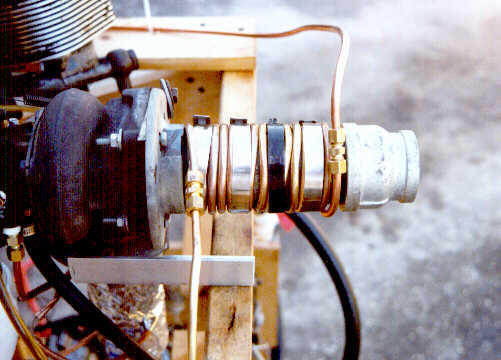 This is the new nozzle made from standard pipe fittings. Here it still has the tubing for the failed propane heat exchanger wrapped around it. |
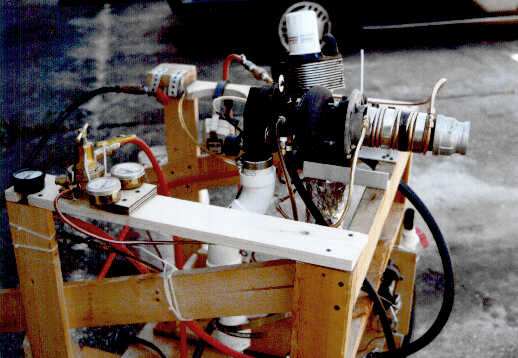 Another view of the engine with the new nozzle and propane vaporizer in place. The upside down propane tank can just barely be seen behind the test stand. |
Today I removed all but 4 of the wraps of the heat exchanger tubing on the nozzle. The propane still gets awfully hot after the engine runs a while, but the surges are not so bad. I think I will give up on using a heat exchanger on the nozzle to vaporize the propane, and probably use the hot cooling water to vaporize it instead. The nozzle just gets too stinking hot. However, the nozzle heat exchanger would probably do a real good job of vaporizing just about any liquid fuel. I'll keep it in mind for the future.
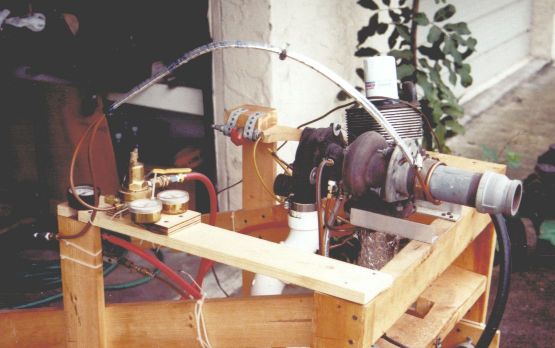 Here is a view of the engine with the propane vaporizing heat exchanger installed. See text for a description |
I now have a satisfactory method of vaporizing liquid propane. I started with a 10 foot length of 1/4 inch copper tubing. I made 4 wraps around the exhaust nozzle in the middle of the tube. The two roughly 4 foot long tails left are clamped tightly together along their length and then soldered together along their length. The whole length of the doubled tube was then wrapped tightly with a spiral wrap of aluminium tape. The last 8 inches of the tube ends separate and one end goes to the propane supply connector and the other goes to the fuel pressure regulator.
In operation the liquid propane passes through the double tube to the loops around the nozzle where it gets heated to a very high temperature and vaporizes. The hot propane vapor passes back through the double tube and is cooled down to a safe temperature by the cold liquid in the other tube, preheating it in the process. The gradual preheating of the liquid propane in this system seems to have eliminated the pressure surges I was getting with the other heat exchanger. I start the engine on propane gas. After about a minute when the nozzle is good and hot I turn the propane tank upside down and start feeding the engine liquid propane.
This system works very well. I have run the engine for as long as 15 minutes at a moderate boost level with no appreciable drop in the propane tank pressure. In the past the pressure would start to drop after only a few minutes and the engine would start to slow down. I should now be able to do the long duration run I wanted to do a month ago to measure the rate of fuel consumption.
Now that I have solved the fuel pressure problem, I need to work on a new fuel injector that will get more fuel into the engine.
12/14/99
Today I tried 2 new fuel injectors. Both should provide more propane at a lower pressure than the one
I have been using. Unfortunately neither one works very well. The engine is very hard to start, runs
real rough and tends to flameout. The exhaust temp is also higher. I suspect that the problem is a
too rich mixture. Opening some of the blocked holes in the flame tube may help, but that would require
tearing down the engine, and I'm not in the mood today, besides it's too hot now. I'll try that
another day. Changing out the injector is one of the few changes I can make on the hot engine without
burning myself, usually.
I put the old injector back in and ran a few tests. It's been cool lately, and my propane tanks are cold. This means the maximum propane pressure I have to work with is 100-110 psi. With the present fuel injector in place the engine tops out at 7 psi of boost at full fuel pressure. I can do better on a warm day when the tanks have more pressure in them, but even in summer I doubt I'll be able to go much beyond 10 psi of boost with this injector and only tank pressure. A higher flow injector and more air holes in the flame holder should help increase power, I hope.
Being limited by the propane tank pressure has got me thinking about liquid fuel. The ability to pump in fuel at whatever pressure I choose is an exciting prospect. I'm leaning toward diesel just because it's so easy to obtain. I bought some misting nozzles from McMaster Carr a while ago. Now I'm going to be looking for a high pressure fuel pump. Someday I'll get it all together.
12/24/99
While messing around with different fuel injectors, I noticed that the part of the flame tube that I
could see was in rather bad shape. I tore down the engine and removed the flame tube to have a good
look at it. I was shocked to find that it was spalling and peeling very badly in several spots. More
than half the thickness of metal was gone in some spots. Since switching to the new turbo, I've been
running the engine at a much higher power level, and it's taking a toll on the flame tube.
I decided that it's time to make a new flame tube out of stainless steel. I found some inexpensive stainless tubing at Don's Salvage Yard. I don't know what type of SS it is, but I'm going to hope it works better than the steel electrical conduit the first one was made of.
12/26/99
The new flame tube is finished and installed. It is essentially identical to the first one except that
I didn't bother drilling out the holes that needed to be plugged on the first one.
I spent the rest of the day fabricating and testing different fuel injectors. I now have a very large collection of fuel injectors that don't work very well, or at all. I am now working with a design suggested by Chris Krug. I don't have the necessary tools to exactly duplicate his design, but I am trying to make something similar. My first attempt worked, but not very well. The engine would only run up to about 4 psi of boost. Attempting to throttle up beyond 4 psi resulted in lots of popping, coughing, and momentary flameouts. My second attempt had similar results, but I can see potential in this design. The two injectors tested today worked better than most others I've tried. I think the problem is that my engine is smaller than Chris' and the new injectors are simply providing too much fuel. I'll try drilling out some with fewer and/or smaller orifices another day. It's cold outside, the propane pressure is low, I'm tired, and it's time to watch football.
02/08/2000
It's been a while since I did any real work on the engine. I've tinkered with it a bit, and
brainstormed ways to convert it to liquid fuel. I've come to the conclusion that the combustion
chamber needs to be rebuilt to work with liquid fuel. Although it works great with propane, the
combustor is just too skinny to allow adequate mixing of the fuel and air before the fuel droplets
impinge on the wall of the flame holder.
Today I found some great pieces of stainless steel scrap at Don's Salvage Yard. They should be perfect for building a new large diameter combustor and flame holder. Total cost $30. I think his price is way too high, but the parts are so perfect for the job that I bought them anyway. I'll post photos of the new parts soon.
The time I spent working on the engine last year put me behind on other projects. Progress on the engine will probably be slow for a while until I get caught up with other things.
05/19/2000
Today I finally found the time to do something I've wanted to do for a long time. I measured the
thrust produced by the engine. I hung the engine from the garage rafters and marked the floor
just below the legs of the engine stand. When the engine was started and throttled up it swung back
a few inches. I marked the floor under the legs again at full throttle. After shutting down the
engine I pulled the engine back with a small scale until it hovered over the second set of marks. The
scale only read 2 to maybe 2.5 pounds. A depressingly small amount of thrust. According to a formula
I saw on the DTT mailing list this equates to at the most 1.5 Horsepower. I wouldn't be surprised if
it was putting out more energy in noise than in thrust.
I unscrewed the nozzle and fired up the engine again. This time there was no measurable thrust even at full throttle. The nozzle is obviously very important for generating thrust. I suspect that a proper nozzle instead of my jury-rigged one may produce even more thrust. I'll need to look into getting one made.
2.5 pounds of thrust probably wouldn't push a lightly loaded bicycle across smooth and level ground. Even with a proper nozzle I doubt I'll get much more thrust on propane. The pressure in the propane tank is the limiting factor. I really need to find the time to work on the conversion to liquid fuel.
Stay tuned for future developments.
[Mike's homepage]
[Mike's telescope workshop]
[Mike's gold prospecting page]
[Mike's home-built wind turbine page]
[Mike's Home-Built Solar Panel page]
